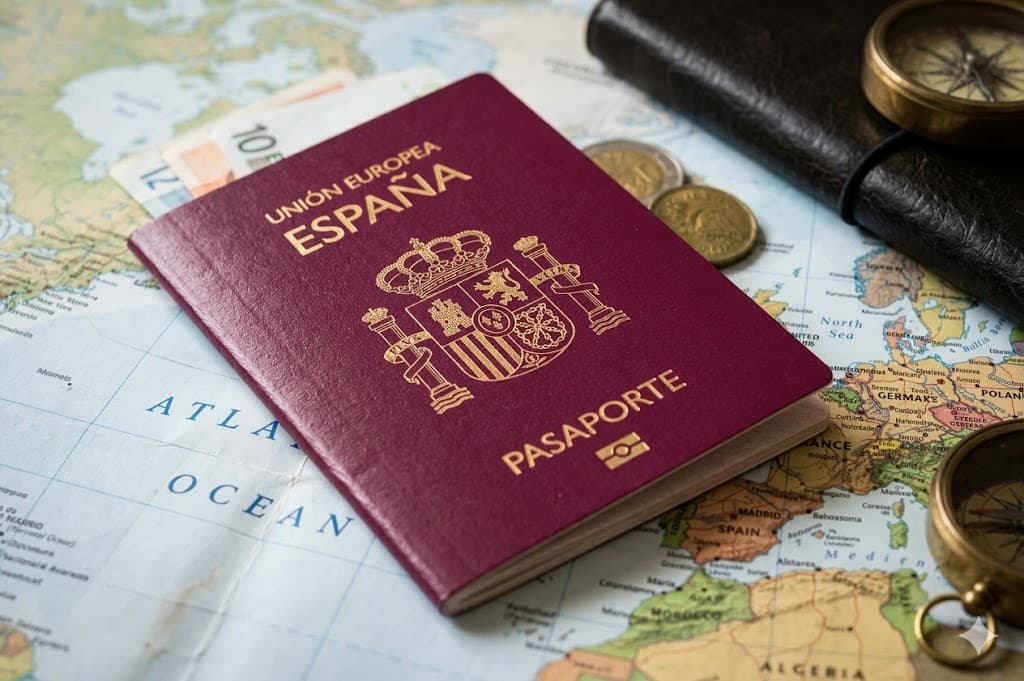
How to obtain Spanish nationality as an Ibero-American citizen: complete 2026 guide
If you are an Ibero-American citizen, you can apply for Spanish nationality with only 2 years of legal residence. We explain the requirements, the CCSE and DELE exams, documentation, processing times for 2026, and how to retain your original nationality.
If you were born in an Ibero-American country and have been living in Spain for some time, you have a tremendous advantage over any other foreign national: you may apply for Spanish nationality by residence after only 2 years of legal residence, compared with the general requirement of 10 years.
In this guide, we explain who is entitled to that reduced period, what requirements you must meet, which exams you need to take (and which ones you are exempt from), what documentation you should prepare, and how long the process currently takes. And, most importantly for most Ibero-Americans: how to retain your nationality of origin when obtaining Spanish nationality.
Quick answer: citizens of Ibero-American countries may apply for Spanish nationality after 2 years of legal and continuous residence in Spain. They are exempt from the DELE A2 language exam (because they are Spanish speakers), but they must pass the CCSE exam on constitutional and sociocultural knowledge. In most cases they do not have to renounce their nationality of origin.
How many years does an Ibero-American need to apply for Spanish nationality?
The general rule for acquiring Spanish nationality by residence is 10 years. However, the Civil Code provides for a reduced period of 2 years for nationals of countries with historical ties to Spain.
To qualify for this period, you must prove 2 years of legal, continuous, and immediately preceding residence before the application. This means:
- Legal: you must have resided with a valid residence permit (time spent in an irregular situation does not count).
- Continuous: with no prolonged absences from Spain that break the continuity of residence.
- Immediately preceding: the 2 years must be the period immediately before filing the application.
Which countries benefit from the 2-year period?
The reduced 2-year period may be applied for by nationals of:
- Ibero-American countries: Argentina, Bolivia, Chile, Colombia, Costa Rica, Cuba, Ecuador, El Salvador, Guatemala, Honduras, Mexico, Nicaragua, Panama, Paraguay, Peru, the Dominican Republic, Uruguay, and Venezuela.
- Other countries with historical ties: Andorra, the Philippines, Equatorial Guinea, and Portugal.
- Persons of Sephardic origin who can prove that status.
If you have doubts about whether your country of birth falls within this group, at Blue Oak we review your specific case before starting any procedure.
Step-by-step legal requirements
In addition to the residence period, to obtain Spanish nationality by residence you must meet the following requirements:
- 2 years of legal and continuous residenceimmediately preceding the application.
- Good civic conduct. This is assessed through the criminal record certificate from Spain and your country of origin, as well as your administrative record (sanctions, proceedings, etc.).
- Sufficient degree of integration into Spanish society. This requirement is proven through two official exams administered by the Instituto Cervantes (CCSE and, where applicable, DELE), which we discuss in the next section.
- Be registered in the municipal registry and maintain lawful status throughout the entire process.
- Pay the fee corresponding to Form 790, code 026.
The exams: CCSE and DELE A2
Integration is demonstrated through two tests administered by the Instituto Cervantes:
CCSE exam (mandatory)
The CCSE (Constitutional and Sociocultural Knowledge of Spain) is mandatory for all applicants, including Ibero-Americans. It consists of 25 multiple-choice questions about the Constitution, institutions, geography, culture, and Spanish society. You pass by answering at least 15 of the 25 questions correctly, and it takes about 45 minutes.
DELE A2 exam (Ibero-Americans are exempt)
The DELE A2 certifies knowledge of the Spanish language. Here is the great advantage for Ibero-American applicants: as a national of a country whose official language is Spanish, you are exempt from taking the DELE A2. You only need to take the CCSE.
Tip: many applications are delayed because the applicant leaves the CCSE until the end. It is advisable to pass it in advance, since the Instituto Cervantes certificate is required to submit the application file.
Required documentation (checklist)
Although each case may require additional documents, this is the basic documentation you will need:
- Birth certificate from your country of origin, legalized or apostilled and, if applicable, translated by a sworn translator.
- Criminal record certificate from your country of origin, also legalized/apostilled and translated.
- Criminal record certificate from Spain.
- Certificate of registration in the municipal register up to date.
- Foreigner Identity Card (TIE) valid.
- CCSE certificate from the Instituto Cervantes.
- Complete and valid passport.
- Proof of payment of the fee (Form 790, code 026).
Common mistakes that lead to denial
- Breaking the continuity of residence with long absences from Spain during the required 2 years.
- Submitting the application with an expired TIE or while being in an irregular status at the time of application.
- Submitting criminal record certificates without legalization, without apostille, or without sworn translation.
- Expired documents: many certificates (criminal record, registration) have a limited validity of 3 to 6 months.
- Failing the CCSE before filing the application.
Updated processing times for 2026
By law, the Administration has a maximum period of 1 year to issue a decision once the file is complete. In practice, processing times have improved significantly thanks to the digitization of the procedure, although they may vary depending on the Ministry’s workload.
If the period passes without a decision, negative administrative silenceapplies, which allows you to appeal. Once nationality is granted, you will have 180 days to swear or promise allegiance to the King and obedience to the Constitution before the Civil Registry and register your new nationality.
Dual nationality: do I have to renounce my nationality of origin?
This is one of the most important and poorly explained questions. The good news for Ibero-Americans is clear:
Spain has dual nationality agreements with most Ibero-American countries. That means that, in practice, you do not lose your nationality of origin when acquiring Spanish nationality. Although when you swear Spanish nationality the law formally requires you to “renounce” your previous nationality, this renunciation has no real effect for nationals of Ibero-American countries: your country of origin continues to recognize you as a citizen and you keep your passport.
In other words: a Colombian, Mexican, or Argentine who obtains Spanish nationality also retains their nationality of origin. It is one of the major attractions of this route and it is advisable to confirm it for your specific case, since the rules of each country of origin may have nuances.
Frequently asked questions
Do the 2 years of residence include time with a student card?
As a general rule, stay for studies does not count as residence for nationality purposes in the same way as ordinary residence. It is advisable to review your specific history before applying.
I have children born in Spain; does that affect my application?
Your children may be entitled to Spanish nationality in their own right (for example, after 1 year of residence if they were born in Spain). Your application and your children’s applications are separate procedures, but they may be processed in a coordinated manner.
Can I travel during the nationality process?
Yes. As long as your residence permit and TIE are valid, you may travel normally. The important thing is not to break the required continuity of residence.
How much does the process cost?
The official fee is low (Form 790-026), but the real cost includes legalizations, apostilles, sworn translations, the CCSE exam fee, and professional fees if you have legal assistance.
Do I need a lawyer to apply for nationality?
It is not mandatory, but a well-prepared file greatly reduces the risk of requests for additional evidence and denials. Most delays are due to incomplete or improperly legalized documentation, something a specialized law firm prevents from the outset.
Process your Spanish nationality 100% online with Blue Oak
At Blue Oak, we are an immigration law firm that operates entirely online. That means you can prepare and submit your entire nationality file from home, without travel or queues. We review that you meet the 2-year period, verify that your documentation is properly legalized and translated, guide you through the CCSE exam, and submit your application electronically, monitoring it until a decision is issued.
If you want to know whether you already meet the requirements to apply for Spanish nationality through the 2-year route, schedule a free initial consultation and we will analyze your case, tell you which documents you need, and how long your file may take.
Do you already meet the 2-year requirement to apply for nationality?
We review your case free of charge and let you know in less than 24 hours whether you are already eligible to apply for Spanish nationality as an Ibero-American national, which documents you need, and how to retain your original nationality — all 100% online.
Free initial consultation